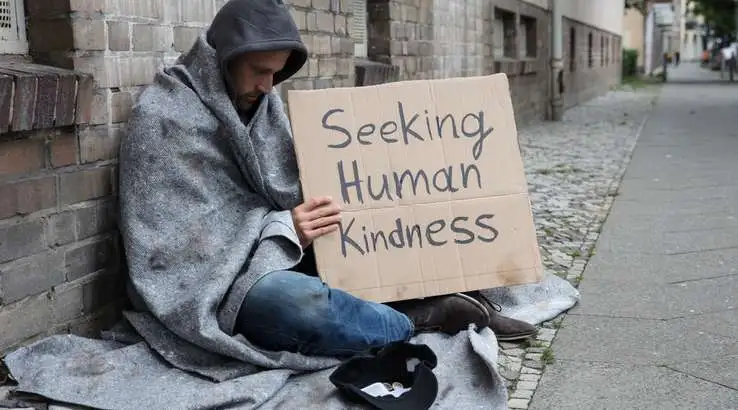
I remember the first time I fully understood that some people didn’t have a home. While on holiday on the Costa Brava in northern Spain as a child, we’d taken a day trip to Barcelona. I saw a man asleep on a cardboard box on the pavement. My nine-year-old brain couldn’t fathom out why he wasn’t at home in bed. When I was told that he didn’t have a home, that some people were homeless, I was shocked. What, he didn’t have a bed with a duvet and blankets of his own? What about a bathroom? How did he keep himself clean? No kitchen! How did he cook?
It rocked my little heart, and I’ve always had a deep empathy for homeless people ever since.
You see, the world prefers to turn a blind eye to homeless people, often calling them “bums.” It´s not a nice word to use, but it’s true. They have landed on their bum. In need of a helping hand, back up. Something has gone wrong in their life. I’m sure no one would live on the streets by choice.
Back in the UK, my homeland, I used to support The Big Issue, an organisation that publishes a weekly magazine by the same name to support the homeless. The Big Issue is a great read with articles that highlight the plight of the homeless, other social justice causes and everyday culture. The Big Issue organisation is different from other publications because only the homeless can apply to become a street vendor and sell copies to make an income. What´s more, the organisation look after their street vendors, helping them gain support to deal with health or social issues they may be facing. The Big Issue calls it a hand up instead of a handout, and I think it’s a wonderful example of how we can help homeless people.
I would buy a copy of The Big Issue from the same vendor close to my work every week. Like many people who support The Big Issue, I was on friendly terms with the vendor, as we chatted over this and that. He was such a lovely man, always more concerned about how I was instead of his problems. He had a drinking problem that forced him onto the streets many years ago, and he was in the process of slowly rebuilding his life, after two years of sobriety at that stage, facilitated by support from The Big Issue organisation.
I would also buy a copy of The Big Issue from every vendor I passed in my day-to-day life, which usually meant that I would have ten or so copies of every week´s issue. I didn’t care. Supporting homeless people trying so hard to get back on their feet was more important.
I left the UK in 2011 to spend eight years of living life as an adventure in Spain. During that time, I would rent places all over Andalucia over the winter and spring, hand the keys back in May, and go on adventures over the summer months. I used to rock up in Malaga, my nearest city, to spend a few days with friends before I hit the road. I’d joke that I’d made myself homeless again.
I feel a little ashamed, now. Of course, I wasn’t homeless. I was travelling and on adventures that some would kill for.
I walked 11 Caminos de Santiago in the last ten years. For those of you who haven’t heard of the walk that is often referred to as “The Way” before, the Camino de Santiago is a network of trails that run throughout Europe, with all Caminos ending in Santiago de Compostela, Spain. Often referred to as a pilgrimage, the good people of the Earth have been walking the Camino since medieval times.
I once read somewhere in a Camino de Santiago book or guide that walking the Camino can give a pilgrim an experience that is similar to being homeless. Don’t get me wrong. It’s very different, but you will see why this is important.
The Camino is the closest some people will ever come to experiencing the feeling of being homeless. Yes, it is very different. Carrying only a rucksack on their back with their earthly belongings for the duration of the trip, never sure whether they will have a bed waiting for them at the end of the day, means that most pilgrims come away from the Camino with a sense of empathy and compassion for the homeless.
All of us should. Every person deserves a helping hand, a warm bed, a place to clean themselves, and adequate food. More importantly, every person deserves to be treated with respect, regardless of whether they have bummed out. You might bum out one day, too.
So, the next time you pass a homeless person, don’t avert your eyes. That person has landed on their bum, my friend. Something has gone wrong in their life. A little compassion, even a smile, can help them back up on their feet.
(c) Samantha Wilson. All Rights Reserved.